

Saving or saving money means not spending today in order to spend in the future. Money is meant to be spent, whether today or in 20 years.
Ideally, you should start making monthly payments, an amount that comes out of your account without making a dent, if possible on a monthly basis. It shouldn't be too low so that you can save an amount that is important to you, but an amount that is not too high that it becomes uncomfortable.
What are the alternatives?
–Demand deposits, recommended for keeping a small amount of money that guarantees you monthly liquidity. These are not usually remunerated, meaning you do not receive interest on them, or else the rate and interest are very low;
–Term deposits: Suitable for short- or medium-term savings, since the rates they offer are not very high;
–PPR:recommended for those thinking long term. In addition to good returns, you also get the security of an insurance company. The goal of the person setting it up may be retirement or something else, but it is advantageous as long as it is long term.
–Life Insurance–Savings account set up with an insurancecompany . It has attractive rates and is a good long-term alternative.
–Stocks, bonds, and other financial investments. Financial instruments that require greater attention, or even a professional manager, so that they do not turn out to be poor savings options.
In the short to medium term, you should prioritize term and demand accounts, but if you have a savings goal of more than 5 years, life insurance or a retirement savings plan (PPR) will be more advantageous (the returns, tax benefits, and security are greater).
What is the long-term advantage of saving in a retirement savings plan?
Firstly, the interest rates that can generally be obtained are higher than those available with other savings instruments.
Also, the capital gains taxes that the state charges (which are withheld by banks or insurance companies) whenever interest is paid are much lower on a retirement savings plan than on a demand deposit, time deposit, stocks, or life insurance.
On the other hand, these taxes are only deducted at the end when the investment is redeemed, rather than annually, with the advantage that they generate interest on interest (compound interest).
In the table below, see which tax applies to each of the alternatives.
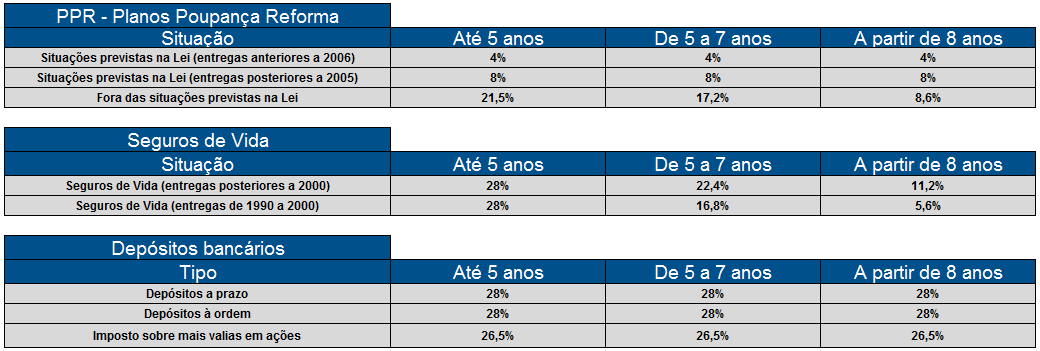
The situations provided for in the law for PPR redemptions are:
– Provided that at least five years have elapsed since the date of the first payment, if the amount of payments made in the first half of that period is > 35% of the total payments and provided that the person is over 60 years of age.
– Complicated situations such as long-term unemployment, serious illness, or death of the insured person.
Which of the available retirement savings plans should you choose?
You should consider several variables before choosing a retirement savings plan:
- What is the expected return on the retirement savings plan you are going to invest in?
- What fees will you be charged? These fees will affect profitability. You should pay particular attention to the management fees charged each year of the contract.
- Which of the available companies offer the most security? When it comes to long-term savings, for five, ten, or even more years, you should take this into consideration.
- If you are a prudent investor, find an alternative with no possibility of capital loss.
The website of the Insurance and Pension Funds Authority (formerly ISP) has atoolthat you can use to compare existing retirement savings plans in Portugal in terms of returns, fees charged, and companies. The analysis is complex.
Talk to us, we can advise you. On thecontactpage, choose Rosa or Rui, specialists in this area.
The most suitable insurance companies

